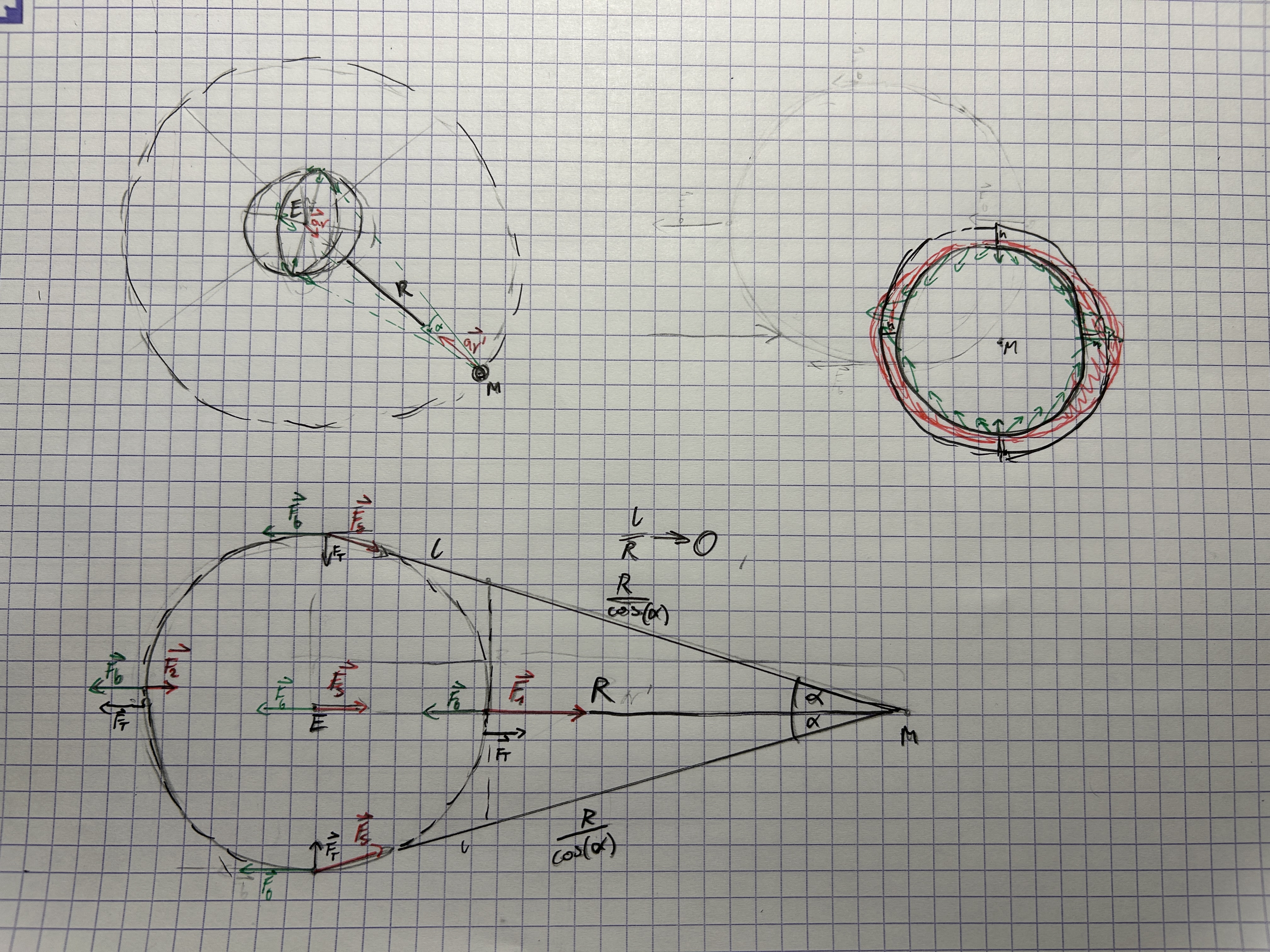
How tides are created
The main reason is that some parts of the planet's surface are further from the satellite than others, therefore they are pulled with a smaller force. This force, combined with an inertial force caused by the small oscillating movement of the Earth, creates the tidal forces. A very important point is that the tidal force acts mostly tangential to the Earth's surface, and water rises because it gets "squeezed" into one place and supports itself.
Most important parameters, and how to control them
Satellite distance
The most important parameter, that's because the gravitational pull increases quadratically, therefore making the forces much stronger. So even a small change to the distance has a strong effect.Planet and satellite mass
These parameters have opposite effects. While a bigger planet mass reduces tides by pulling the piled-up water down, a bigger satellite mass amplifies the tides by making the pulling force stronger.Planet radius
This is quite interesting since it has several effects. First, it strengthens the tides, because the gravitational force on the surface is weaker (remember, we are only changing the radius — the mass stays constant). It can also drain certain areas, because the volume of water stays the same but now has to cover a larger surface area.Ocean height
This one is pretty straightforward — it just changes the base water height compared to what it would be on a planet with the default radius.Scales
Large scales are needed to make a simulation like this visually appealing, otherwise the tides would be almost invisible. I left some room for manual control, in case you want to see the effect more clearly without being fully constrained by the laws of physics.Others
The other parameters, just like the scales, are purely visual.